- Austin's Newsletter
- Posts
- Why The Allocation Economy changes everything
Why The Allocation Economy changes everything
New rules for winning in the age of AI - The AI Playbook Vol. 1

Austin Marchese
November 04, 2025

In 1776, Adam Smith published Wealth of Nations and described what would drive economic progress for the next 200+ years: the division of labor.
If you specialize deeply in ONE thing. Doctor. Lawyer. Engineer — and you’ll make a lot of money.
By 2011, Harvard doubled down with an article about Hyperspecialization. The more specialized you were, the more valuable you became. This is what is called, The Knowledge Economy.
That game just ended.

We're entering what I call the Allocation Economy—where you get compensated for effectively directing AI systems, not for having knowledge yourself.
Here's how to visualize it:
The Sculptor vs. The Gardener
A sculptor chips away at stone, manually creating every detail.
A gardener plants seeds, then manages conditions for growth.
The sculptor directly creates the final product. The gardener facilitates creation—soil, water, sunlight—but doesn't create the fruit themselves.
In the AI era:
The sculptor is the Task Executor (doing everything manually)
The gardener is the Model Manager (directing AI to do the work)
The sculptor competes with machines. The gardener manages them.
"The IT department of every company is going to be the HR department of AI agents in the future."
This is a fundamental shift—and I get why it's hard to accept.
I spent years painfully teaching myself how to code. Late nights, endless debugging, building expertise from scratch. That skill was my security blanket, I would say: "I can always get paid to write code."
Moving from task execution to task management means acknowledging that skills you spent years building are now worth…less.
But you're not throwing away your skills—you're repositioning them.
The expertise doesn't disappear. It moves up the value chain. And it's creating an opportunity for those who embrace the shift.
Positioning Adjacent to AI's Growth
When cars were invented, if you were in the horse business, you were screwed. If you were in the transportation business? You got richer.
The difference? The transportation business was adjacent to the new technology. The horse business competed against it.
Want to know where your job sits? Download WEF's 2025 Future of Jobs Report, upload to NotebookLM, and ask: 'Analyze how vulnerable my role is and which adjacent skills I should develop.’
We need to position ourselves adjacent to AI's growth. When AI gets better, your role becomes more valuable, not less.
The most important skill in the Allocation Economy? Managing AI systems effectively.
Here's the opportunity: Only 10% of the current workforce has managerial skills. Most people have spent their careers executing, not managing.
But AI is forcing everyone to become managers whether they're ready or not. By 2030, 67% of all work will involve managing AI systems. This creates what I call an Impact Arbitrage Opportunity.
The fewer people who know how to manage AI effectively, the more valuable you become relative to your peers.
But this arbitrage won't last forever. In 18-24 months, AI management will be table stakes.
The good news? Management skills transfer directly from humans to AI, so there’s an exact playbook to follow.
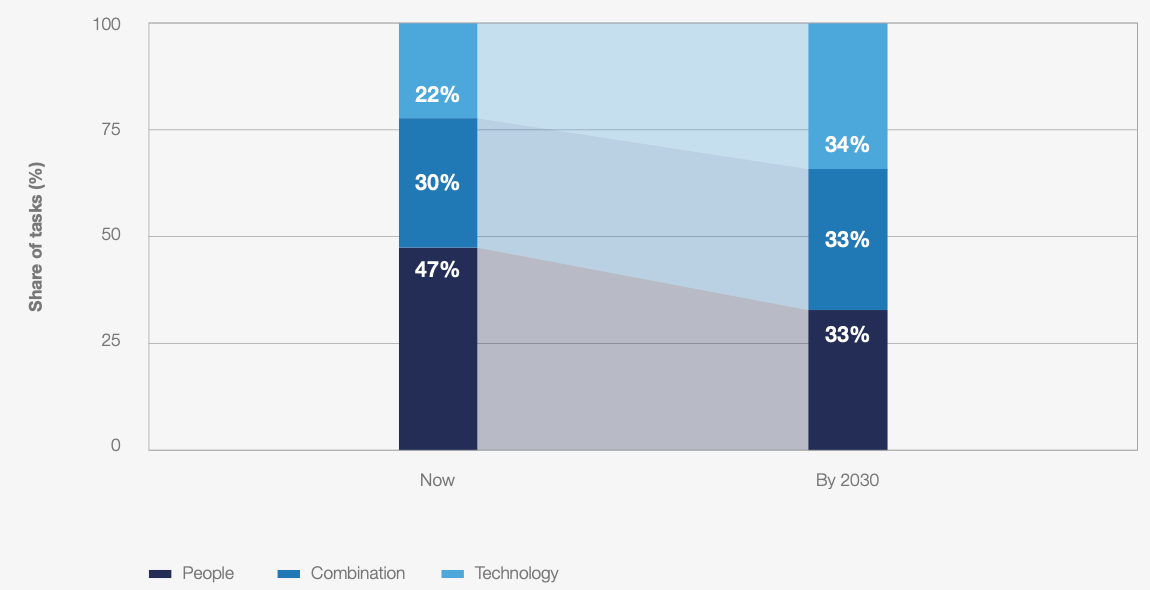
Source: World Economic Forum, showing how work is going to shift by 2030. 67% of all work will use technology
What Makes a Great AI Model Manager?
The best managers excel at: (1) Training with high-quality context, (2) Providing clear feedback. Both transfer directly to AI.
1. Training = Context Engineering
Good managers train employees on how the company thinks, what 'good' looks like, and why certain approaches work.
With AI, this is Context Engineering—bringing non-digital information into the system. The expertise in your head. Patterns you've recognized. Edge cases you've seen
Real example: At IYK, we worked with Ed Sheeran, Tate McRae, and Chance the Rapper on drops in an entirely new product space. AI models didn't have this information—it wasn't in their training data.
We became the context. We documented our processes, deal structures, and quality standards. By providing our proprietary knowledge to AI tools, we were able to reduce our legal bills. We handled routine contract reviews with AI—combining OUR context with AI’s existing legal knowledge base. That's Context Engineering in action.

2. Providing Clear Feedback
When I first started hiring for The Incubator, I had never managed anyone. After trial and error, I landed on a feedback framework I've used for years—and it works perfectly for managing AI.
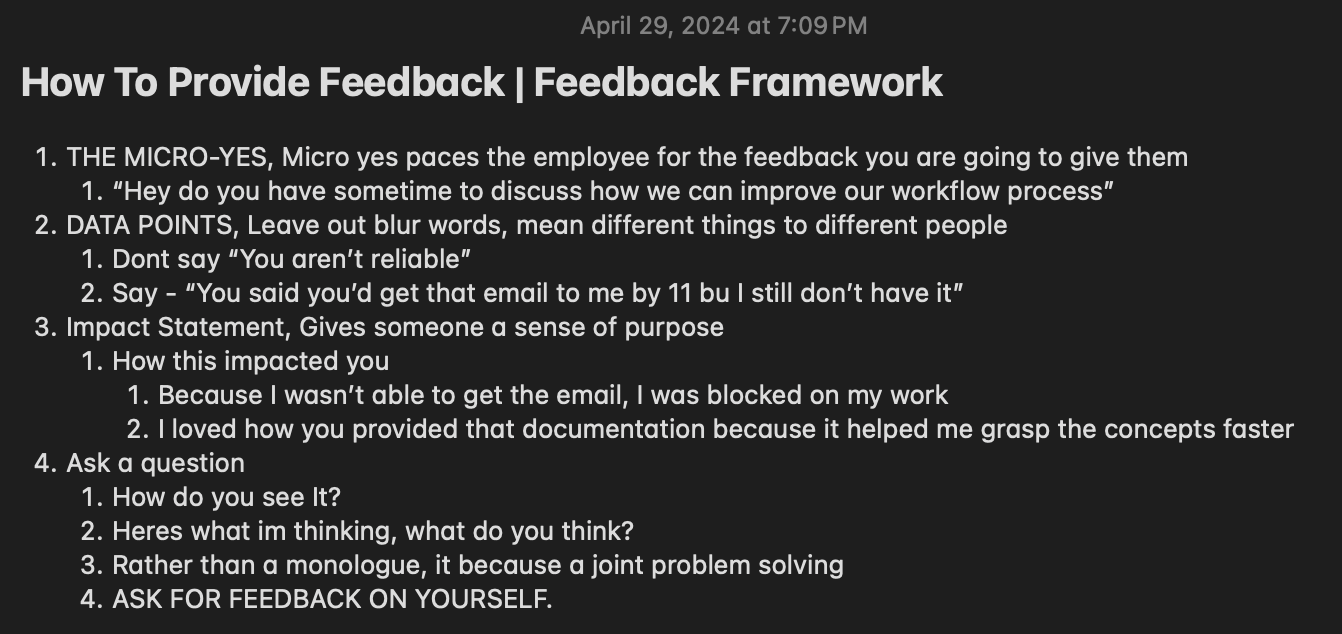
Here’s the feedback framework I use for humans.
Here are the 3 steps to provide high-quality feedback to your AI employees:
1. Use Concrete Examples (Remove Ambiguity)
❌ Bad: "Make this better" ✅ Good: "This section is too generic. Here's what good looks like: [paste specific example]. Rewrite using this specificity level."
With AI, this could be: 3 examples of your best work, 2 examples of past mistakes to avoid, Specific quality criteria from your domain
2. Understand the Reasoning
With humans: 'Walk me through your thinking.'
With AI: 'Show me your reasoning before final output.'
Why this matters: If you don't understand how AI arrived at an answer, you can't fix the root issue. Use Claude or ChatGPT's 'thinking' models to see chain of thought.
3. Iterate with Specific Direction
❌ "Try again" ✅ "Keep sections 1-3. Rewrite section 4 using [FRAMEWORK]. Add concrete example from my context doc."
The compounding effect: Every feedback cycle trains the AI on YOUR specific work. You're not just getting one good output—you're building an employee that improves forever.
Before I give the exact playbook to become a AI Model Manager, if you have ANY questions on this - I'm hosting a free group call on November 12th with unfiltered thoughts on AI's current state and answers to your specific questions. Reserve your spot here
Don’t worry, there will be no upsells on this call 🤣 — just real conversation. I keep these intentionally small for specific Q&A. So it’s first come, first serve.

What would I do TODAY to start becoming a AI Model Manger? I’d Train Your First AI Employee (something everyone can do)
Step 1: Choose Your High-Leverage Task
Pick one recurring task. Look for task with:
Repetitive structure (reports, research, proposals)
Clear quality standards you can articulate
Low cost of error if AI gets it wrong initially
Step 2: Build Your Training Document
Create '[Task Name] Training Manual' with:
The Goal: Be specific. "Identify 3 actionable insights executives can use Monday"
3 Best Examples: Your best past outputs (shows AI what "excellent" looks like)
2-3 Common Mistakes: "Don't use technical jargon for executive audience"
Quality Criteria: "Each insight needs: data point, implication, recommended action"
I prefer using Google Docs for training documents like this because most AI tools have direct integrations with Google. This means you can have a single file that gets shared across multiple products.
Step 3: Create Your AI Workspace
Upload training doc to Claude or ChatGPT Projects
Step 4: Run Task with Active Management
Use the feedback framework:
"Section 2 is vague. Rewrite like Example #1 from training doc"
"Show me your reasoning before final output"
"Keep intro. Rewrite analysis using '3-point framework' from training"
At the end of your back and forth, prompt “Based on the feedback I provided, can you re-create the training doc so you will avoid these mistakes in the future”. Each feedback cycle improves future outputs.
Step 5: Iterate
Can you provide better context? Further isolate the task? The best way to find leaks is to run water through the hose—as you use these tools, you'll find improvements.

I recently left my role as COO at IYK (previously raised $18.9M) to go all-in helping young professionals become irreplaceable with AI. Every framework in this newsletter comes from real experience—managing engineering teams at JPMorgan, growing my own agency, and scaling a tech startup. I am very excited.
What to expect: I’ll be sending monthly emails with strategic frameworks and actionable insights that position you as an AI leader—not just a tool user. No hype, just proven systems that will position you to win. If you received this email, it’s because you subscribed through my Youtube or Instagram, so also make sure to stay up to date there.
This week, I covered The Allocation Economy. Until the next one…keep building.
(Reminder to book your spot in the free group call I’m hosting on November 12th, linked here)
-Austin