- Austin's Newsletter
- Posts
- The "iPhone" Moment for AI
The "iPhone" Moment for AI

Austin Marchese
February 04, 2026

I'm currently living in South Africa, and while at a co-work, an older man did something wild…
He pulled out a manila folder, unfolded a map, and started planning a trip using magazine clippings as reference.
That's how most people are using AI right now.

In the early 2000s, a product called the "Palm Pilot" launched and it was marketed as your "digital personal assistant."
It could track appointments, take notes, run calculations. Pretty awesome.
But there was one critical problem: it couldn't call people.
So you had to carry both a Palm Pilot AND a cell phone.
Then came Blackberry, which was smarter… but still only for power users.
Then the iPhone arrived. It removed all the friction, added calling, and boom - the smartphone revolution was upon us.
The same thing's happening with AI.

ChatGPT launched in late 2022 and absolutely exploded. But it had a similar problem to the Palm Pilot: it was READ-only.
It could give YOU information, but it couldn't DO things on your behalf.
And then the "AI Agent" wave came. AI tools that completed tasks for you. But we were in the Blackberry phase: technical setup, limited access, clunky interfaces, foundational models that just weren't good enough.
But then OpenClaw launched…
You might know it as Clawdbot or Moltbot, the names it went by before rebranding. This tool went batsh*t viral. Why?
Because OpenClaw put the missing pieces together. It let you create an AI Agent that can access everything you need it to access, and produce high quality results quickly and consistently.
An AI Agent that lets you read AND write. Or as OpenClaw would say “The AI that actually does things.”
What this looks like in practice, is having an assistant you can message “Run a report on all my unanswered emails every morning at 7AM and tell me the highest priorities.” And then…it just…does it, continuously, without asking, until you tell it to stop. Teach once, never teach again.
My Setup
Think of it as your personal assistant with specific access. You give it access to specific tools: web search, data analysis, communication channels, scheduling. The same way if you had a human assistant you might give them your login info to your email, or your Amazon account to order things. You give it exactly what you want it to have access to.
Here's what I did:
Set up my own "personal computer" on Amazon AWS (5 min)
Downloaded & setup OpenClaw (10 min)
Gave it access to the internet using Exa MCP (1 min)
Gave it access to Slack, Posthog, Notion, Telegram (~15 min)
That's it. From there, you’ll realize what’s missing and enhance it over time.
For non-technical people: Start with Claude Cowork. It's simpler, safer, and getting better fast - especially after OpenClaw showed what's possible.
I put together a walkthrough for both options here.
Either way: start with one low-risk task. Build trust. Expand from there.
Ways I use it:
Daily operations: It monitors my Slack channels and summarizes what actually matters. I have it constantly analyzing my content database on Notion and suggesting ways it can help. This runs daily at 7AM EST.
Funnel analysis: I built this tool called isthisreal.ai - it tests whether you can tell if images are real or AI-generated. I asked my assistant to analyze usage, graph the results, and send me updated graphs every six hours.
Every six hours, without prompting, it pulls data, generates graphs, and sends them. I set that up once.

isthisreal.ai analysis
Stock analysis: Sometimes when I see the market tank, I want real time info and don’t feel like figuring out the answer myself. A quick message to my assistant and we’re good to go.

$HOOD price drop analysis from AI Assistant
Here's what changed my thinking: it remembers.
Every preference it learns, every workflow you teach it, compounds. A human assistant might take three months to fully understand how you work. An AI assistant gets there in a week - and never forgets.
If you’re enjoying this you’ll love my free 5-day email series about how to become Irreplaceable with AI (sign up here). Based on reviews from thousands of other readers like you, I bet you’ll love it. - Austin
The Real Skill Here
Here's what most people miss: the value isn't in the AI. It's in what you allow it to access.
Everyone has access to the same foundational models. ChatGPT, Claude, Gemini - they're basically commodities now.
What's not commoditized? Your judgment about what to connect, in what order, with what guardrails.
The person who figures out "give it Slack read-only first, then Notion after a week, then email only for drafts" is developing a skill that didn't exist six months ago: permission architecture.
This is a new form of delegation. And just like learning to delegate to humans took trial and error, learning to delegate to agents will separate people who "use AI" from people who are irreplaceable because of it.
As someone who runs a team, I now default to "can I have my AI assistant do it" instead of "can I have my team do it." You should do the same.
But much like giving an intern access to your information, there's risk. The more access you give, the more you have to trust these tools. That takes time.
Start in a sandbox. Understand what you're giving it permission to do. Expand gradually as you build trust. Don't rush into full access.
With great power comes great responsibility.

Why This Matters Now
OpenClaw showed Frontier AI labs that people want these features, which means billions of dollars will be leveraged to make the functionality of AI Agents better.
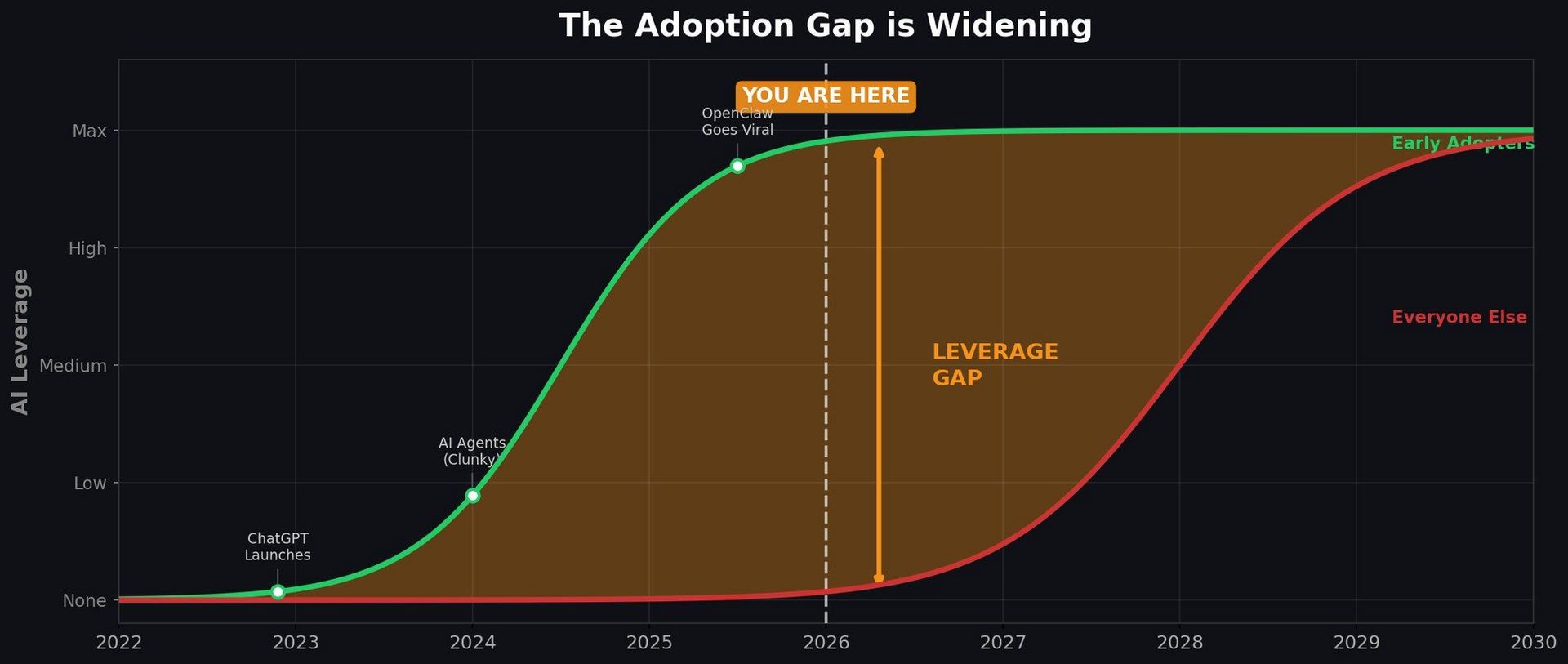
The gap between AI-agent users and everyone else will be bigger than the gap between internet users and people who relied on libraries. And just like the internet, the people who adopt early will have a compounding advantage.
This is what I mean by positioning yourself adjacent to AI's growth, not against it. When agents get better - the person who knows how to direct them benefits. The person still doing everything manually is competing with the machine, a battle you will unfortunately…lose.

Set up your assistant this week. Pick one simple task. Maybe it's researching a stock. Maybe it's summarizing your Slack channels. Maybe it's just sending you a recipe. The key? Schedule it to run every morning or every night. When you see it proactively doing something you previously taught it…that will be your “aha moment”
The smartphone moment for AI just happened and if it isn’t obvious today it will be in 6 months.
Let's build.
P.S. If you’re a business owner and interested in working with me to transform your company into an AI-First Operation and save yourself 10+ hours a week, click here and book a free consultation call to see if you’re a good fit.