- Austin's Newsletter
- Posts
- The decision you'll regret in 2027
The decision you'll regret in 2027
Jeff Bezos's framework applied to AI in 2026 - The AI Playbook Vol. 3
Austin Marchese
January 08, 2026

This Jeff Bezos framework changed my life and it might change yours.
Every January, people set goals. The problem? They make them based on their life TODAY, which makes them near-sighted.
But when Jeff Bezos was debating quitting his job to start Amazon, he didn't ask "What do I want to do this year?"
He asked: "What will I regret NOT doing when I'm 80?"
He called it the Regret Minimization Framework.
Using this framework, the decision for Bezos became obvious. He quit his job, started Amazon, and now I get packages delivered in less than 2 hours, thank you Bezos.
Right now, you're facing a similar decision with AI.
You know it's important. You're reading this newsletter because of it. But you're not sure what to actually do about it.
So here's the question: With this framework, what can you do TODAY to minimize regrets?

How this framework has changed my life…
I've used this framework for 3 key decisions:
In 2014, I first was around crypto and I waited to get involved. In 2019, I said "I won't regret going all in on crypto and getting it wrong. But I will regret watching from the sidelines." I started working in the industry (Bitcoin ATMs) and it changed my life.
In 2023, I had to choose between my agency and IYK. I didn't want to regret asking "what if." I became IYK’s COO, we raised $18.9M from a16z, and helped Ed Sheeran go number 1 (was pretty dope)
Then, October 2025, I got that same feeling with AI I had in 2019 with crypto. I couldn't watch from the sidelines anymore. I transitioned from IYK to go all in. I needed to be adjacent to AI's growth.
Now…How does this apply to you?

My Regret Minimization Journey
You know AI is important, but going "all in on AI" just isn't realistic for you. Which is fair - everyone's situation is different. But here's how I think of it.
Risk is on a spectrum. On one side is quitting your job but on the other side is spending 10 minutes each morning experimenting with AI.
One is extremely aggressive and puts you in financial risk, but the other is just risking your time. You sacrifice 10 minutes of guaranteed dopamine hits from scrolling Instagram for 10 minutes of learning.
I'm not saying quit your job. But there is some spot on that spectrum that is realistic to you, and you need to find that spot.
So the question becomes: How can you position yourself so Jan 1 2027, you feel good about the year? And 5, 10, 20 years from now you're not saying "I wish I took that AI thing more seriously?"

Risk Spectrum

What Separates Winners from Everyone Else
“Where should I focus my energy?” I've worked with hundreds of professionals navigating this exact decision. Here's what works.
Stop chasing AI tools. Instead, focus on building your Personal AI Augmentation System.
No matter where you are on that risk spectrum - everyone can commit 3 hours to this. This isn't quitting your job. This isn’t pivoting your business. It's not even changing your routine. It's 3 hours to set up a system that compounds for the rest of the year.
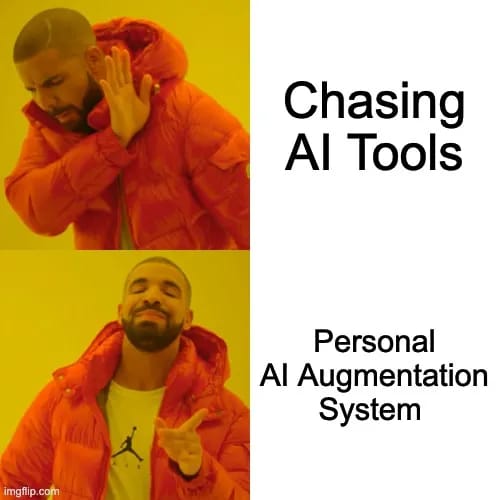
PHASE 1: LOCK IN YOUR STACK (30 Minutes)
Most people treat AI tools like a grocery store. Shopping around and trying new tools every week. But unfortunately, it creates a massive AI Tool Graveyard.
Each time you try a new tool, it requires you to learn new interfaces, re-build prompts, and learn best practices. And each new tool you try means more time lost to context switching (the modern cigarette) and you never make any REAL progress.
So instead, here's what you should do:
Pick your core AI tool stack and commit. Then every 30 days, search for SPECIFIC tools you have a use case for. I.e. if you spend a lot of time revising people's writing, maybe there's a tool that streamlines THAT (in this example, type.ai would be the tool you could add to your stack).
My recommended stack:
Claude for writing & Claude Code for coding ($20/month)
Grok for real-time research (Free)
Nano Banana for image generation (Free)
Any AI in the big 4 for general purpose (Claude, Gemini, ChatGPT, Grok)
NotebookLM for research (free)
If your company requires you to use a specific AI, use that tool outside of work. Skills compound when you use the same tools everywhere.
Once you commit to a stack, stop looking around, and decision fatigue disappears.
PHASE 2: BUILD YOUR WORKSPACE (1.5 Hours)
We're entering what I call the Allocation Economy - where you get compensated for directing AI systems, not for having knowledge yourself.
Think chef vs. restaurant owner. The chef cooks every dish - limited capacity. The restaurant owner trains staff, manages multiple cooks - scales output.
The chef is competing with AI and the restaurant owner is adjacent to AI (where we want to be). And the best restaurant owners know how to train their staff.
So here's how you to TRAIN your AI workforce:
Would you hire someone and throw them into work on day one with zero context? No. You'd train them. Show them what good looks like.
Same with AI.
Two types of training data you need:
Type 1: Your Best Work - Past outputs that represent your standards. Reports, emails that landed, proposals that closed. This teaches AI YOUR voice.
Type 2: Your North Star - Examples BETTER than your current work. A colleague's output that impresses people. A competitor's piece that resonates.
Your Best Work improves efficiency. Your North Star improves quality.
To set this up:
Use Projects (Claude, Grok, ChatGPT), Gems (Gemini), or Spaces (Perplexity).
Create a workspace for your most repeated work
Upload 3-5 examples of your best work
Add 1-2 North Star examples
Write custom instructions (use AI to help: "Write an optimized system prompt for [project details]")
Now every conversation has your context.
While everyone else re-explains their situation to ChatGPT for the 400th time, your system already knows you.
Pro Tip: Go on a walk, use voice-to-text and talk through your entire life story. Where you've worked, your experience, what you like, your goals. Save this as your "Personal Life Story." AI will better understand YOU for high-level career questions.
btw - If you’re a business owner and interested in working with me to transform your company into an AI first operation and save yourself 10+ hours a week, click here and book a free consultation call to see if you’re a good fit. - Austin
PHASE 3: TEST AND REFINE (1 Hour)
Run a real task through your workspace.
Compare the output to what you'd normally produce.
Give feedback: "Keep section 1-2, rewrite section 3 using the style from Example #2."
After landing on a response you like, say "Update the system prompt so we could land on this response the first time." This creates a data loop where you provide feedback to your system and it improves over time. The earlier you start the more this will compound.
There's a line from A Bronx Tale: "The saddest thing in life is wasted talent."
That talent only gets wasted through inaction.
On January 1st, 2027, what would you say about the choices you're making today?
Jeff Bezos knew he wouldn't regret trying. He'd only regret not trying.
I learned this with crypto, then IYK, now AI. Each time I acted, my life changed. Each time I hesitated, I regretted it.
Do one thing this week: Start Phase 1. Pick your stack and commit.
Not building an entire system - just the first step that makes the next steps inevitable.
Because the biggest regret isn't trying and failing.
It's never trying at all.
Cheers to 2026, Let's build.
- Austin
P.S. I send specific free resources to subscribers based on what they’re working on. Help me personalize this for you (fill out this 30 second form)